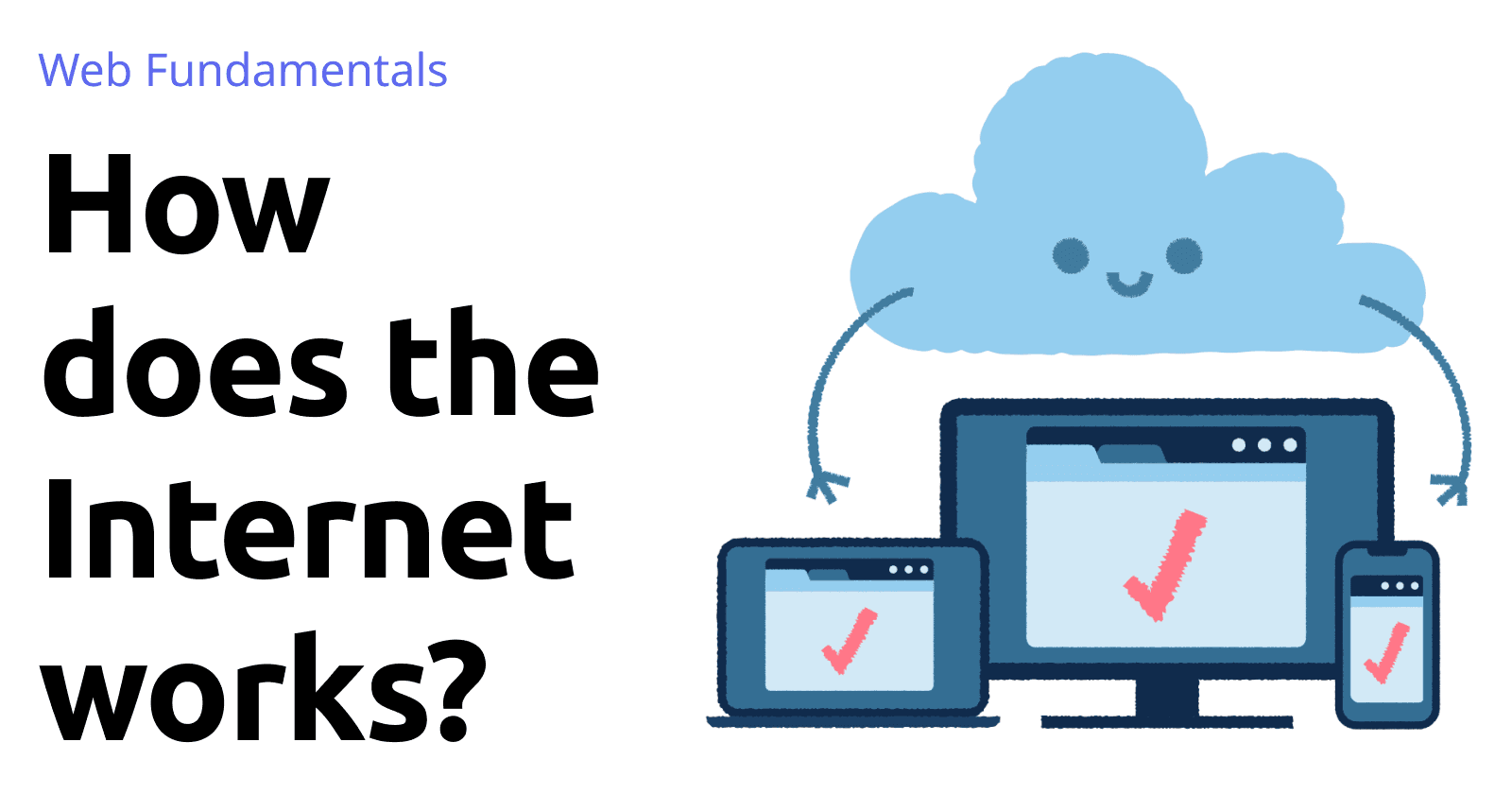
How does the Internet works?
I’m a Software Engineer from India, currently building AI solutions for networking as a MTS at Aviz Networks. I like developing products to make user experience simple yet helpful. Connect with me at anubhavdxt46@gmail.com.
How does the Internet works?
Nowadays, Internet has become an essential part of our lives, and we need the Internet for daily purposes. Whether searching for resources to study or watching a movie on any OTT platform, we need the Internet.
In this article, we will try to understand the functioning and basics of the Internet and how it gets to us.
But, before we proceed further, you need to understand some general terms, they may not make much sense to you now, but we will understand them more clearly in our further reading.
Technical terminology
Network
A network is a connection of two or more computers connected with the help of an ethernet cable or wirelessly with wi-fi or Bluetooth.
Switch
The switch is a device used to connect the devices to communicate. It has ethernet ports, and all the devices are associated with an ethernet cable. We need a switch device to make a wired network by connecting two or more computers with an ethernet cable.

LAN
Local Area Network is a network connecting the computers of a small area with a switch to make them communicate with each other.

Router
A router is a device used to connect a LAN to the Internet.

Modem
A modem is equipment that connects our network to the telephone infrastructure. This modem turns the information from our network into information manageable by the telephone infrastructure and vice versa.

WAN
Wide Area Network extends over an extensive geographical area, comprising countries to continents. It is a network of Local Area Networks.
ISP(Internet Service Provider)
An ISP is a company that manages some special routers linked together and can also access other ISPs' routers. So the message from our network is carried through the network of ISP networks to the destination network. The Internet consists of this whole infrastructure of networks.
Packets
In networking, the packets are a smaller chunk of the more extensive information containing both data and information about itself. Information stored inside it is known as 'header,' which tells a computer what to do with its data.
Protocols
In networking, a protocol is a standardized way of doing specific actions and formatting data so that two or more devices can communicate with and understand each other. The protocol is needed because we need a common language for the devices with different hardware and software to communicate over the Internet.
Now, as we are familiar with the above terminology, we'll move forward to our main topic.
Why is distributed networking important for the Internet?
There is no control centre for the Internet. Instead, it is a distributed networking system, not dependent on any individual machine. Any computer or hardware that can send and receive data accurately (e.g., using the correct networking protocols) can be part of the Internet.
The Internet is resilient due to its distributed nature. Computers, servers, and other pieces of networking hardware connect and disconnect from the Internet all the time without impacting how the Internet functions — unlike a computer, which may not function at all if it is missing a component.
Connecting to the Internet (A network of networks)
A small number of computers are connected to transmit information in a local area network. But when we need to communicate to a computer outside our network, we need to connect to another local area network.

But it's not possible to set cables up between your house and the rest of the world, so how can you handle this? Well, there are already cables linked to your home, for example, electric power and telephone. The telephone infrastructure already connects your house with anyone in the world, so it is the perfect wire we need. We connect our network to the telephone infrastructure with a modem.
The next step is to send the messages from our network to the network we want to reach. To do that, we will connect our network to an Internet Service Provider (ISP). An Internet connection and a router are needed to connect to the Internet. The router allows a local area network to communicate with the Internet and send messages outside a network.

Whenever a message is sent to a device outside of a local area network over the Internet, it first goes to the router; the router checks the message's destination and sends it to the other router. This process continues until the message reaches its destination.
Intranet & Extranet
Intranet is a private network owned by a single organization and is a tool for sharing information throughout the organization. Since the intranet is a private network, no one can use the intranet without a valid username and password.

The extranet is also a private network like an intranet owned by either a single or many organizations. It is managed on a contractual basis between organizations and facilitates sharing of information between internal and external members.
Future of Internet
In the coming time, the Internet will take over our lives, from streaming music to turning off the light of our bedroom, and we will be doing everything with the help of the Internet. It has already made our lives very simple. We use the Internet for our day-to-day tasks, from searching for our assignment questions to searching for a particular recipe. We use it for almost everything.
Building a better and safer Internet
The invention of the Internet is a significant achievement on its own, but it doesn't always work as expected. Networking issues and malicious activity can slow down Internet access or block it together.
Third parties can spy on user activities, leading to abuse and, in some cases, government repression. Internet protocols and processes were not designed with security and privacy in mind since the people who first designed and built the Internet were more concerned with getting it to work than making it perfect.
However, we as a developer should work on building the Internet safer by contributing to the development of new, more fast, and secure protocols and educating users about the working of Internet technology, etc.
Conclusion
So this is a brief idea about how the Internet works. If you want to know more about its working and deep dive to understand everything, you can refer to the links below in the resources section.
Also, if you like my content, you can support me with a 👍 and you can catch me on Twitter, Instagram, LinkedIn and if you also like to host your repositories on GitHub like me, you can find me there also GitHub.
Feedbacks are most welcome.